Put a crypto wallet on the big screen with nobody’s funds in it.
Whether it is a product demo, an investor deck, a talk or a lesson, you get a wallet on your phone whose prices move when they should and whose quantities stay put when you want them to, and none of it is a real balance.
$19$29$39 per month · stop whenever you like · card payments go through Stripe
Preparing a talk with it
One state for each beat of the story.
Keep one account per moment in the talk: before, after, the awkward case. Begin by swapping the stock ghost avatar and search text, since both refer to a real wallet app whose home screen the layout follows. If you want to see the wallet first, our homepage shows it in a phone frame.
Open it on the phone you will hold up.
Mirror the display or film the phone. Launched from the home screen, it fills the screen like any app.
Say what it is while you show it.
Put “Illustrative UI, sample data” on the slide and say one sentence out loud. Wallet mockups sized for slides may help.
What a presenter keeps
Nothing that can leak.
No address, no balance and no history that belongs to a person. A real wallet on a projector displays all three, and this article lists what a real screen discloses.
Live where you want it, frozen where you need it.
While you speak, the five built-in tokens keep following the market. The quantities do not move from where you left them.
The situation your story calls for.
Use several accounts, custom tokens, a cash row and a light or dark theme, with the rows in the order you chose.
Drawn by the engine
A wallet whose name says what it is, a portfolio sorted by value, and three chains for a lesson.
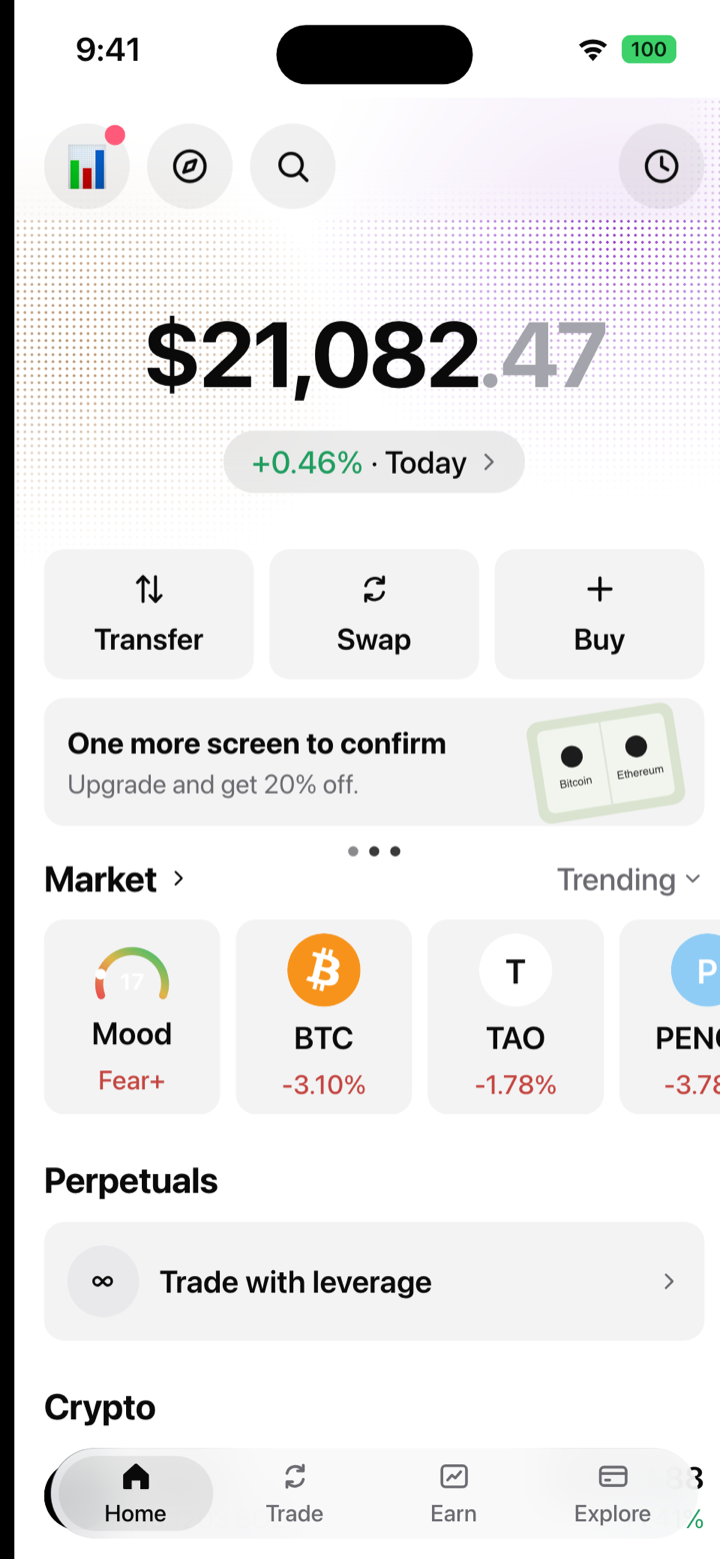
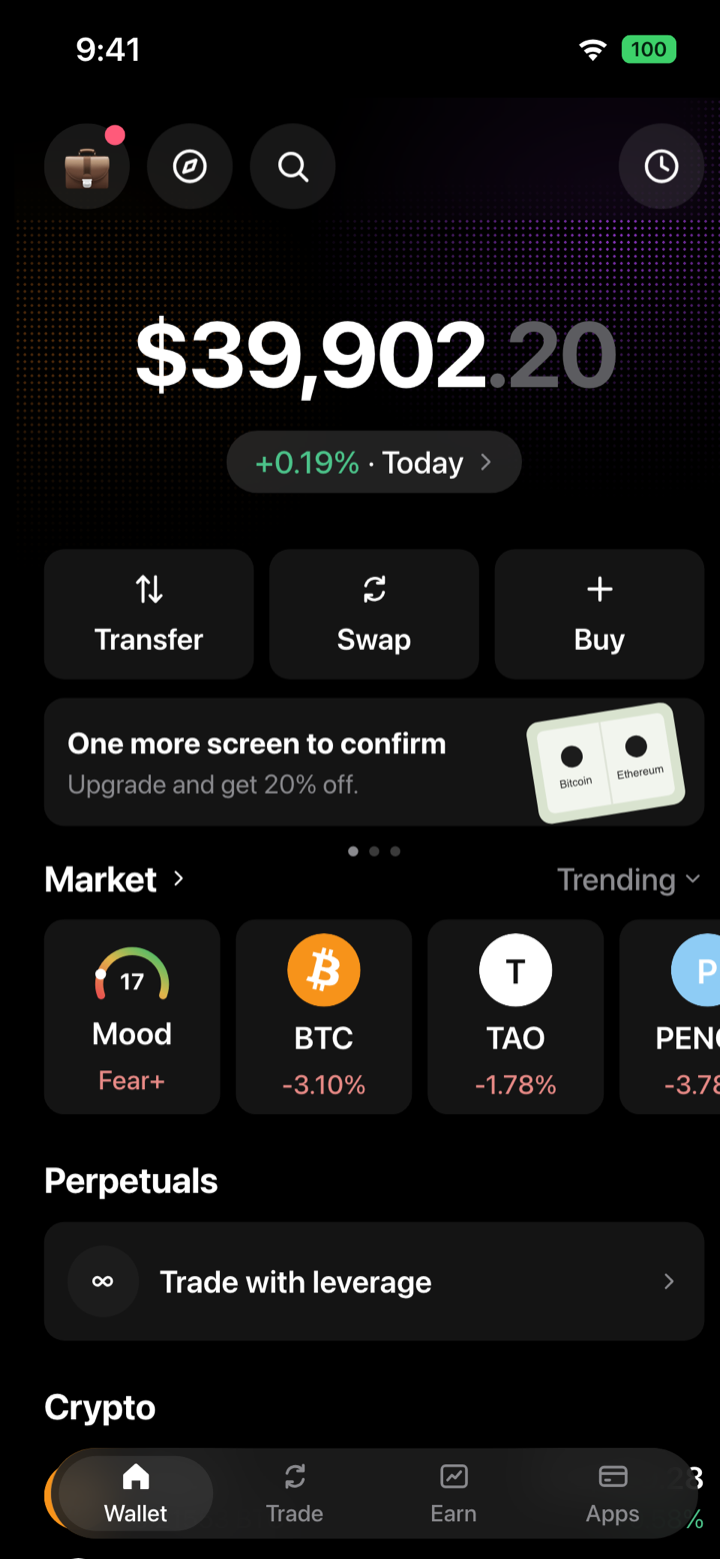
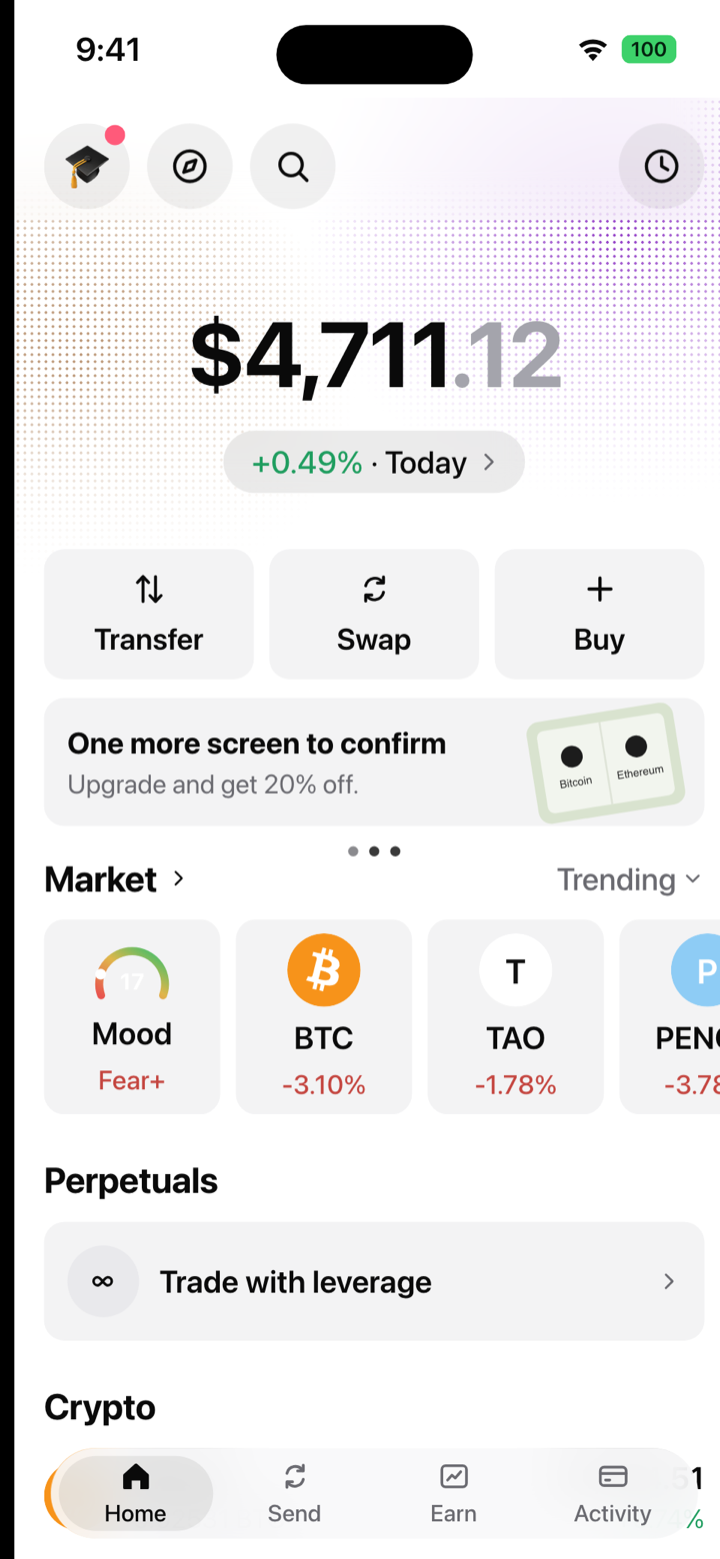
A mockup, not a wallet: composed in Flexdger Wallet. Nothing is held in it and it joins no chain. The clock, signal and battery in these pictures come from our renderer; on your phone the wallet gives that strip back to the real status bar.
Real figures belong somewhere else
Put traction on a chart with a period and a source, and never inside a mockup. In a deck, a wallet screen shows the product; it can never stand for assets under management, users, revenue or proof of funds. Our advice on showing a portfolio screen in a crypto pitch deck goes further.
Totals an audience can check
For a slide with a portfolio, or a wallet interface to talk through with a class or a team, the layout is the same: the total at the top, the day’s change beneath it, and the rows in the order you chose, each a quantity multiplied by a price. Because the arithmetic holds, the first test an audience applies is passed. Here is what such a screen has to get right. By hand, every one of those sums must be redone after each edit, as this comparison of drawing a wallet screen explains. To work out a total before composing, the free crypto portfolio calculator multiplies each quantity by its live price.
If you teach
You need no accounts and no student devices. Project the wallet that our homepage displays, where nothing can be edited, and have the class work on paper from a still of it. The 45-minute lesson plan uses that screen and closes by asking why a screenshot proves nothing.
Reading for the demo and the deck
- Crypto pitch deck: how to show a portfolio screen on a slideReadable at slide size, which numbers to choose, and the honesty rule.
- Running a wallet demo live, in front of a roomWhat fails on stage, what to prepare, and when the real app is the better call.
- Fake data in a product demo: where the line actually isWhat everybody does, when it becomes misrepresentation, and how to label it.
- Is sharing a wallet address or a screenshot safe?What an address and a screenshot give away, why blurring fails, and what to show in their place.
- Crypto demo account, paper trading, wallet simulatorWhich one trades, which one moves test coins, which one only draws, and where a testnet belongs.
- How to make a crypto portfolio mockup that adds upThe total, the 24-hour change, decimals by chain, and the order of the rows.
- Which tokens a wallet mockup drawsHow each mark is drawn, what other tokens get instead, and the fallback badge real wallets use.
Screens by chain
In class
- Teaching crypto wallets in class without real money or real keysA 45-minute lesson in which students open a practice wallet on their own device.
- A crypto wallet portfolio screen, taken apartMeasured layout: cards, radii, icon sizes and the hairline that lifts a card off the page.
- How to spot a fake crypto wallet screenshotTotals that fail to add up, impossible timestamps, rounding that is too neat.
- What a hardware wallet simulator can and cannot showWhy a device screen and a phone app screen are not the same thing.
Our articles on composing and checking a wallet screen are collected in crypto wallet simulators and mockups. For the product itself, see Flexdger Wallet, a crypto wallet simulator that runs in your browser.
Questions
What is a larp wallet?
A larp wallet, also called a crypto wallet app simulator, renders a wallet screen that looks genuine from numbers you enter yourself, for a video, a sketch, a pitch deck or a demo. Nothing is held in it and no chain is ever read. In a deck or a live demo, it lets you show the wallet step with nobody’s real money on the screen.
Can I show it to investors?
Only as a labelled illustration of the product, and never as assets, users or revenue. Presenting a mockup as a financial position breaks our terms and misleads the people you are asking for money. The licence is personal (terms, section 4) and says nothing about business use, so write to us first for a company deck.
What happens if the venue wifi fails?
The built-in tokens need a connection to follow the market. Capture each beat on the phone before the talk so that it does not hang on the network.
Can a class use it without accounts?
Yes, with one projected screen. The teacher opens our homepage, which shows the wallet with no sign-in, and students work on paper from a still of it. Nothing on that page can be edited.
Can I get the screen as an image for my slides?
There is no export. Take the screenshot on the phone at its own resolution, then crop it to fit the slide.
A wallet for the room, with nobody’s money in it.
Set up each beat once, open it on your phone, and present it with its label.
Resume my walletGet my walletOpen my wallet$19$29$39 per month, or $97$147$197 one time for life
Stop whenever you like · card payments go through Stripe
Flexdger Wallet builds interface mockups. It is not a wallet: nothing is held in it and no chain is ever read. Every quantity shown was typed by hand, and the only real numbers are the market prices of the five built-in tokens. Using a screen as proof of funds, as a statement, or to get money out of someone breaks our terms.
More uses: Creators · Crypto wallet app builders